
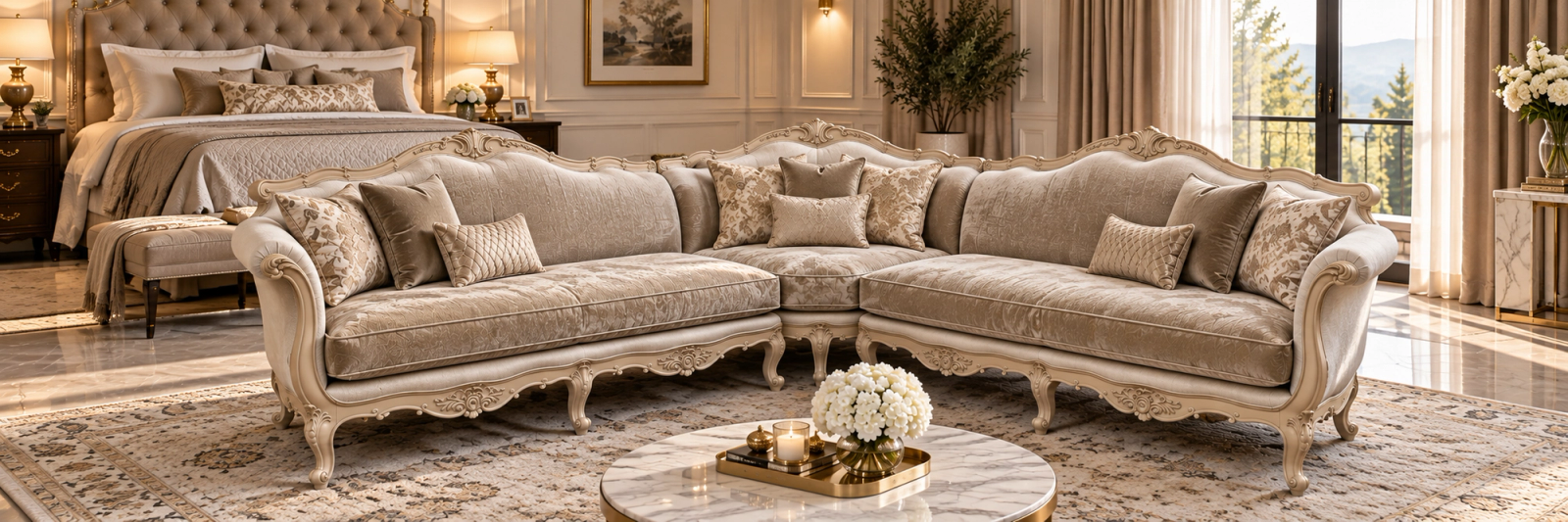
Most L shape sofas that look wrong in a living room are not badly made. They are the wrong size, bought from a photo, in a room nobody measured.
An L shape sofa solves a real problem. It seats five or six people in the floor area that a three-seater plus two chairs would eat, and it pushes the seating to the edges so the middle of the room stays open. It only works if the dimensions are right, and standard sizes are built for an average room rather than yours.
This guide covers what to measure, which way the chaise should face, and what you are actually paying for inside the frame.
It also covers the part most guides skip: what separates a plain upholstered corner unit from a hand carved, Maharaja style L shape sofa, where the wood is meant to be looked at rather than hidden under fabric. That is a different piece of furniture at a different price, and the questions you ask before ordering one are different too.
Measure before you look at designs
Three numbers decide everything.
The long wall. Measure the wall the main run will sit against, then subtract at least 12 inches. A sofa that runs wall to wall makes a room look like a waiting area, and you lose the ability to clean behind it.
The return. The chaise arm usually runs 60 to 70 inches out from the main run. Stand in your room and mark that distance on the floor with tape before you commit. People consistently underestimate how far into the room it comes.
The walkway. Leave 30 to 36 inches of clear path between the sofa and whatever it faces. Below 30 inches people turn sideways to pass, and they will notice it every day.
Typical L shape sofa footprints, in inches:
- Compact. Main run 78, chaise return 55. Suits a room of 10 × 11 ft and up.
- Standard. Main run 90, chaise return 62. Suits a room of 11 × 13 ft and up.
- Large. Main run 108, chaise return 70. Suits a room of 13 × 15 ft and up.
Seat depth is separate and worth deciding on purpose. Around 22 inches suits sitting upright. Around 26 inches suits lounging but leaves shorter people without back support unless they use cushions.
One thing to allow for on a carved design: a hand carved arm and an exposed carved base add three to five inches of width per side that you cannot sit on. If the room is tight, measure the carved version, not the plain one.
Left-facing or right-facing chaise
Stand at the main entrance to the room and look in. If the chaise extends to your left, it is a left-facing sofa. To your right, right-facing.
The rule is that the chaise should not block the path from the door into the room. Put it on the side away from the doorway, so people walk in along the open side and the long arm runs toward the far wall or the window.
Two other things decide it. If the room has one good view or a television on one wall, the chaise should face it, not sit beside it. And if the room is open to a dining area, the back of the chaise can be used deliberately as the divider between the two.
This is the one decision that cannot be undone later, so mark it on the floor with tape and live with it for a day before ordering.
The frame is what you are paying for
You cannot see the frame. That is exactly why it is where cost gets cut.
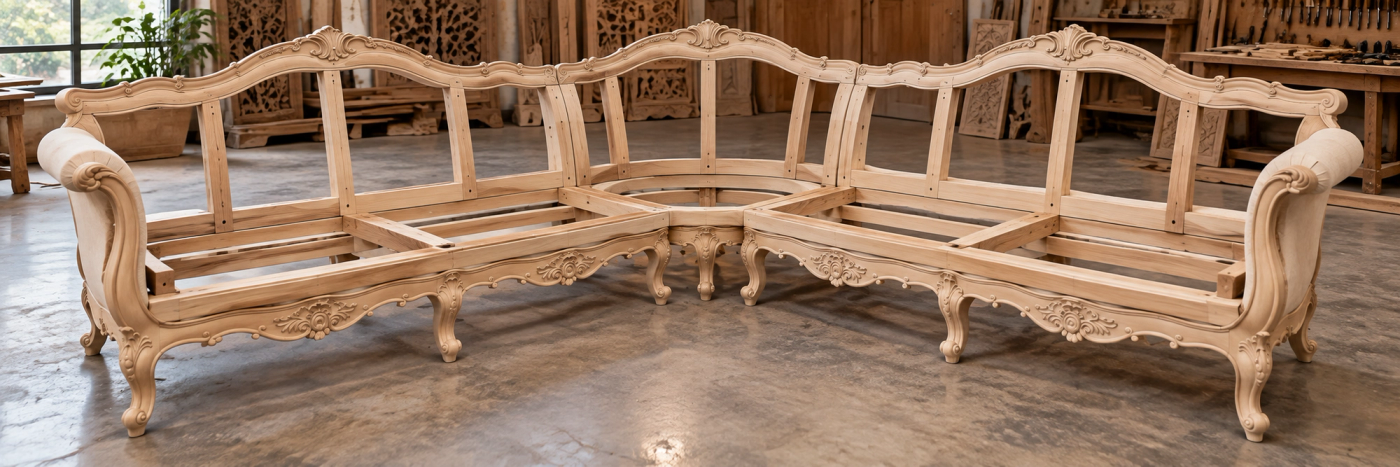
A solid wood frame in teak or sheesham holds its geometry under load for decades. Composite and hollow frames sag at the corners and start creaking within a couple of seasons, and by then the upholstery still looks fine, which is why people blame the cushions.
Questions worth asking before you order:
- What is the frame made of, including the parts you cannot see? Some sofas use solid wood for the legs and visible rails and particle board everywhere else.
- How are the corners joined? Corner blocks that are glued and screwed are what stop the frame racking sideways over time.
- What supports the seat? Webbing stretches and eventually sags. Serpentine steel springs hold longer. Solid slats are firm and last, but give a harder seat.
- What is inside the cushions? High density foam holds shape. Low density foam flattens in the middle seat first, because that is the one everyone sits on.
- Is the carving cut into the frame or glued on? Hand carved detail is worked into the solid timber of the arm, base rail and crest, so it is part of the structure. Moulded appliqué is stuck to the surface and lifts at the edges within a few years.
Maharaja style: what hand carving actually buys
The carved L shape sofa people mean when they say Maharaja style is a specific thing: a scrolled arm, a crested back rail, a carved apron running along the base, and cabriole legs, all cut by hand in solid teak or sheesham and then upholstered between the woodwork rather than over it.
It is the most expensive way to build a sofa and it is worth understanding why. A carved crest rail is cut from one thick piece of timber, so the workshop starts with far more wood than the finished part uses. The carving itself is days of work per length, done by hand, and it cannot be corrected once cut. Then the upholstery has to be fitted around the woodwork instead of wrapped over a plain box.
Two practical consequences for a room, on top of the price:
- Carved detail wants light. The whole effect is shadow in the cuts. A carved sofa pushed into a dark corner looks like a plain one that cost four times as much.
- Carved detail collects dust. A dry brush every couple of weeks, into the grooves, keeps it sharp. A cloth just moves dust deeper into the pattern.
If you want the luxury register without the full weight of it, carve the arms and the base apron and leave the back plain. Most of what the eye reads is at arm and knee height anyway.
L shape sofa design for a small living room
A small room does not rule out an L shape. It rules out a badly chosen one.
Raise it off the floor. Exposed legs of five or six inches let you see floor underneath, and the room reads as larger. A sofa sitting flush to the ground in a small room looks like a block.
Keep the arms low and slim. Wide rolled arms can add ten inches of width that you do not sit on.
Choose an armless chaise end. It gives you the same lounging length in less floor space.
Skip the recliner mechanism. Recliners need clearance behind them and add bulk to the back, and in a small room that is space you cannot spare.
Wood and fabric
Teak and sheesham are the two frames worth considering for a sofa you intend to keep. Teak handles humidity best, which matters because a sofa frame sits low where damp collects. Sheesham is heavier and takes a carved wooden arm better, which suits a more traditional look.
For hand carved work the choice tightens. Sheesham holds the finest detail, which is why most heavily carved, heritage-style pieces are cut in it. Teak carves a little softer and broader, and it is the one to pick if the room is humid or the sofa sits near an open verandah. Either way, a carved frame should be finished in a polish that sits in the grain rather than a thick lacquer, which fills the cuts and flattens the detail you paid for.
On fabric, the practical order is straightforward. Cotton blends breathe well in heat but stain easily. Polyester blends resist stains and fade less in sunlight, which matters if the sofa sits near a window. Velvet looks expensive and traps dust, so it is a poor choice in a dusty city unless you will vacuum it. Leather and leatherette get hot in Indian summers unless the room is air conditioned.
On a carved frame, a plain or lightly textured fabric in a quiet colour does more for the piece than a patterned one. The pattern and the carving compete, and the carving loses.
Ask for removable, washable cushion covers whatever fabric you pick. It is the single change that most extends how long the sofa looks new.
What an L shape sofa costs
Price varies from ₹150,000 to ₹500,000.
What pushes the price up: fabric grade, carving on the arms, seat depth, and storage under the chaise. Hand carving is the single largest step. A plain solid wood L shape sofa and a fully hand carved one in the same timber and the same fabric are not the same order of work, and the gap between them is labour, not materials.
When you compare two quotes, the gap is almost always in three places: the frame wood in the hidden sections, the foam density, and the seat support. Ask about all three, because none of them are visible in the photograph you are comparing. On a carved piece, add a fourth: whether the carving is cut by hand into solid wood or moulded and applied.
Care
Vacuum the crevices monthly, more if you have pets. Rotate the cushions so the middle seat is not the only one taking weight. Keep the sofa out of direct afternoon sun, which fades fabric unevenly and dries out a wooden frame over years. Wipe the wooden legs and arms with a dry cloth and polish them once a year, same as any other solid wood furniture.
Carved sections need the dry brush more often than the cloth, for the same reason a carved headboard does: cloth pushes dust further into the detail instead of lifting it out.
Having one built to your room
At Woodstocks Enterprises the layout and dimensions are worked out with the customer first, then the frame is built in solid teak or sheesham, hand carved where you want it, and upholstered to the fabric you choose. See the L shape sofas we build. If the bedroom is next on the list, the same applies to a made-to-order bed, built to the size of your room.
A piece like this takes around two to three months to build. We ship pan-India and abroad: the shipping policy has the detail.
Send the room measurements and which side your door is on over WhatsApp, and the workshop in Saharanpur will work back from there.
Frequently asked questions
How much space does an L shape sofa need?
A standard layout runs about 90 inches along the main wall and 62 inches out for the chaise, so it suits rooms from roughly 11 by 13 feet. Leave 30 to 36 inches of clear walkway in front of it. Mark the chaise return on the floor with tape before ordering.
Should I choose a left-facing or right-facing chaise?
Stand at the room's main door and look in. Put the chaise on the side away from the doorway so it does not block the path into the room. If the room has a television or a window view on one wall, the chaise should face it rather than sit alongside it.
Does an L shape sofa need a solid wood frame?
The frame decides how long the sofa holds its shape. Solid wood resists sagging and creaking for decades, while composite frames give way at the corners within a few seasons even though the upholstery still looks new. It affects durability far more than appearance.
What makes a Maharaja style L shape sofa different?
The woodwork is meant to be seen. A scrolled arm, a crested back, a carved base apron and cabriole legs are cut by hand into solid teak or sheesham, and the upholstery is fitted between the carving rather than wrapped over a plain frame. It costs more because hand carving is days of skilled work per length, and it asks for a well lit spot and a dry brush every couple of weeks in return.
Can an L shape sofa work in a small living room?
Yes, with three adjustments. Choose exposed legs of five or six inches so floor is visible underneath, pick slim arms or an armless chaise end, and avoid recliner mechanisms, which need clearance behind and add bulk. A compact 78 inch layout suits rooms from about 10 by 11 feet.
Which fabric lasts best on an Indian sofa?
Polyester blends resist stains and hold colour near windows. Cotton blends breathe better in heat but mark easily. Velvet traps dust and suits low-dust rooms only. Whatever the fabric, ask for removable washable covers, which does more for how long the sofa looks new than the fabric choice itself.
Have a piece in mind?
Every piece is made to order in your choice of wood, finish and dimensions. Tell us what you are thinking and we will talk it through.